sábado, 5 de febrero de 2011

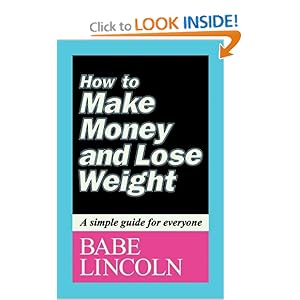
How to Make Money and Lose Weight: A simple guide for everyone

How to Make Money and Lose Weight: A simple guide for everyoneYou can do this. If you want to make money and lose weight, you already have everything you need to do it successfully. You don't need financial advisers. You don't have to pay commissions. You don't have to go to meetings. You don't have to buy special products. You have everything you need, right there in the space between your ears. With humor and insight, author Babe Lincoln shares her map to the mistakes and pitfalls that stand between you and your goals. She'll show you how to make money and lose weight, and even better, how to hang on to those gains and losses. Learn "How to Lose Money on Cars," "Why You Yo-Yo," and how to live by Lincoln's Law: The more money they're spending to sell it to you, the less you need it.
Price: $9.95

Click here to buy from Amazon

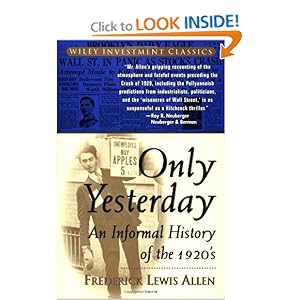
Only Yesterday: An Informal History of the 1920's (Wiley Investment Classics)

Only Yesterday: An Informal History of the 1920's (Wiley Investment Classics)Only Yesterday
Hailed as a classic even when it was first published in 1931, Only Yesterday remains one of the most vivid and precise accounts of the volatile stock market and the heady boom years of the 1920's. A vibrant social history that is unparalleled in scope and accuracy, it artfully depicts the rise of post - World War I prosperity, the catalytic incidents that led to the Crash of 1929, and the devastating economic decline that ensued—all set before a colorful backdrop of flappers, Al Capone, the first radio, and the "scandalous" rise of skirt hemlines. Now, this mesmerizing chronicle is reintroduced to offer readers of today an unforgettable look at one of the most dynamic periods of America's past.
With a novelist's eye for detail and a historian's attention to the facts, Frederick Lewis Allen tells a story that will ignite your imagination as its rich pageant of characters and events comes alive. Peppering his narrative with actual stock quotes and financial news, Allen tracks the major economic trends of the decade and explores the underlying causes of the Crash. Here are fresh accounts of Harding's oil scandals and the growth of the automobile industry, as well as the decline of the family farm, the Coolidge prosperity, and the long bull market of the late twenties. Allen's virtual hour-by-hour account of the Crash itself, told from multiple perspectives with mounting suspense, is as gripping as anything you are likely to read in fiction.
In addition to his power as a storyteller, Allen was a living witness to the events he describes; there is a thrilling you-are-there feeling about the unfolding history. After a brief "return to normalcy" following the War, the pace of life in America quickly escalated to a full gallop. New forces were being unleashed: prosperity with serious inflation, larger-than-life figures such as J. Pierpont Morgan and Henry Ford, and the Big Red Scare of the early twenties. Allen documents the new inventions, fads, and scandals as they affected the daily life of the country, including the impact of Freud and Einstein, Prohibition and Al Capone, Babe Ruth and Jack Dempsey, the trial of Sacco and Vanzetti, and the shocking changes in manners and morals. In Only Yesterday we hear America talking to itself from coast to coast, furiously debating its own rapidly evolving destiny.
An engaging narrative that describes the harried, often tumultuous events of Wall Street in the twenties, as well as the infectious spirit of the times, Only Yesterday is not only a compelling account of years gone by, but a true classic that will be appreciated for years to come.
"When this fascinating social history of America in the 1920's was first published in 1931, the twenties were indeed Only Yesterday. But, as Mr. Allen makes clear, they were so much more than the clich— would have it. . . . Frederick Allen's marvelous book brings back an exciting time in the life of the nation. I am quite sure you will enjoy reading it as much as Mr. Allen and I enjoyed living it." —from the Foreword by Roy R. Neuberger.
Recognized as a classic even when it was first published in 1931, Only Yesterday is a fascinating and revealing chronicle of the volatile stock market and heady boom years of the 1920's. Written by an esteemed historian who witnessed firsthand the explosive atmosphere and events of the time, this compelling narrative takes its place as one of the most important and invaluable contributions to investment literature.
Acclaim for Only Yesterday
"Marvelously absorbing . . . Only Yesterday tells the story of the 1920's from the collapse of Wilson and the New Freedom to the collapse of Wall Street and the New Era." —Stuart Chase, Books.
"A perfectly grand piece of historical record and synthetic journalism." —Fanny Butcher, Chicago Tribune.
"A style that is verve itself . . . Besides telling the story of the bull market in fine perspective, Mr. Allen presents the first coherent account that we have seen of the oil scandals that will eventually make the Harding regime match that of President Grant and the Crédit Mobilier story in the history books of the future." —John Chamberlain, The New York Times.
Price: $32.50

Click here to buy from Amazon

viernes, 4 de febrero de 2011

The Baby Business: How Money, Science, and Politics Drive the Commerce of Conception

The Baby Business: How Money, Science, and Politics Drive the Commerce of ConceptionA Bold Examination of the Hidden Commerce of Conception
Despite legislation that claims to prohibit it, there is a thriving market for babies spreading across the globe. Fueled by rapid advances in reproductive medicine and the desperate desires of millions of would-be parents, the acquisition of children?whether through donated eggs, rented wombs, or cross-border adoption?has become a multibillion dollar industry that has left science, law, ethics, and commerce deeply at odds.
In The Baby Business, Debora Spar argues that it is time to acknowledge the commercial truth about reproduction and to establish a standard that governs its transactions. In this fascinating behind-the-scenes account, she combines pioneering research and interviews with the industry?s top reproductive scientists and trailblazers to provide a first glimpse at how the industry works: who the baby-makers are, who makes money, how prices are set, and what defines the clientele. Fascinating stories illustrate the inner workings of market segments--including stem cell research, surrogacy, egg swapping, "designer babies," adoption, and human cloning--as Spar explores the moral and legal challenges that industry players must address.
The first purely commercial look at an industry that deals in humanity?s most intimate issues, this book challenges us to consider the financial promise and ethical perils we?ll face as the baby business moves inevitably forward.
Price: $26.95

Click here to buy from Amazon

Purchase Order & Letter of Credit Financing


Many business opportunities come with an associated challenge. For most entrepreneurial businesses, the greatest challenge is financing the business opportunities created by your sales efforts. What are your options if you have a sales opportunity that is clearly too large for your normal scale of operations? Will your bank provide the necessary financing? Is your business a startup, or too new to meet the bank's requirements? Can you tap into a commercial real estate loan or a home equity loan in sufficient time to conclude the transaction? Do you decline the order? Fortunately there is an alternative way to meet this challenge: You can use Purchase Order Financing & Letter of Credit financing to deliver the product and close the sale.

What is purchase order financing?

Purchase order financing is a specialized method of providing structured working capital and loans that are secured by accounts receivables, inventory, machinery, equipment and/or real estate. This type of funding is excellent for startup companies, refinancing existing loans, financing growth, mergers and acquisitions, management buy-outs and management buy-ins.

Purchase order financing is based upon bona fide purchase orders from reputable, creditworthy companies, or government entities. Verification of the validity of the purchase orders is required. The financing is not based on your company's financial strength. It is based on the creditworthiness of your customers, the strength of the commercial finance company funding the transaction, and in most cases a letter of credit.

What is a letter of credit?

A letter of credit is a letter from a bank guaranteeing that a buyer's payment to a seller will be received on time and for the correct amount. If the buyer is unable to make payment for the purchase, the bank is required to cover the full amount of the purchase. In a purchase order financing transaction, the bank relies on the creditworthiness of the commercial finance company in order to issue the letter of credit. The letter of credit "backs up" the purchase order financing to the supplier, or manufacturer.

Is purchase order financing appropriate for your sales program?

The perfect paradigm is a distributor buying products from a supplier and shipping directly to the purchaser. Importers of finished goods, exporters of finished goods, out-source manufacturers, wholesalers and distributors can effectively use purchase order financing to grow their businesses.

Is purchase order financing appropriate for growing your sales orders?

Purchase order financing requires you to have management expertise- a proven track record in your particular business. You must have bona fine purchase orders from reputable firms that can be verified. And you must have a repayment plan; often this is from a commercial finance company in the form of accounts receivable or asset-based financing.

You should have a gross margin of at least 25% to benefit from purchase order financing. Sellers of services or commodities with low margins, such as lumber or grain, will not qualify.

The bottom line decision for purchase order financing:

It can take two or more years to develop a profitable business. Banks generally base their lending limits on a business' performance for the past two or three years. Purchase order financing, combined with letters of credit and/or accounts receivable or asset-based financing can give you sufficient funds to cover your operating costs, financing costs and still realize significant profits. If you qualify for purchase order financing, you can grow your business by taking advantage of large purchase orders and eventually qualify for bank financing.

Copyright ©2007

Gregg Financial Services


Mr. Elberg is a licensed attorney and licensed real estate broker. Gregg Financial Services is a full service brokerage for commercial finance companies and banks that fund B2B businesses. Mr. Elberg arranges funding from $25,000 to $50 million per month at competitive pricing, and works to reduce your financing costs as your company grows. For more information about GFS, please visit our website: http://www.greggfinancialservices.com


Small Business Finance - Finding the Right Mix of Debt and Equity


Financing a small business can be most time consuming activity for a business owner. It can be the most important part of growing a business, but one must be careful not to allow it to consume the business. Finance is the relationship between cash, risk and value. Manage each well and you will have healthy finance mix for your business.

Develop a business plan and loan package that has a well developed strategic plan, which in turn relates to realistic and believable financials. Before you can finance a business, a project, an expansion or an acquisition, you must develop precisely what your finance needs are.

Finance your business from a position of strength. As a business owner you show your confidence in the business by investing up to ten percent of your finance needs from your own coffers. The remaining twenty to thirty percent of your cash needs can come from private investors or venture capital. Remember, sweat equity is expected, but it is not a replacement for cash.

Depending on the valuation of your business and the risk involved, the private equity component will want on average a thirty to forty percent equity stake in your company for three to five years. Giving up this equity position in your company, yet maintaining clear majority ownership, will give you leverage in the remaining sixty percent of your finance needs.

The remaining finance can come in the form of long term debt, short term working capital, equipment finance and inventory finance. By having a strong cash position in your company, a variety of lenders will be available to you. It is advisable to hire an experienced commercial loan broker to do the finance "shopping" for you and present you with a variety of options. It is important at this juncture that you obtain finance that fits your business needs and structures, instead of trying to force your structure into a financial instrument not ideally suited for your operations.

Having a strong cash position in your company, the additional debt financing will not put an undue strain on your cash flow. Sixty percent debt is a healthy. Debt finance can come in the form of unsecured finance, such as short-term debt, line of credit financing and long term debt. Unsecured debt is typically called cash flow finance and requires credit worthiness. Debt finance can also come in the form of secured or asset based finance, which can include accounts receivable, inventory, equipment, real estate, personal assets, letter of credit, and government guaranteed finance. A customized mix of unsecured and secured debt, designed specifically around your company's financial needs, is the advantage of having a strong cash position.

The cash flow statement is an important financial in tracking the effects of certain types of finance. It is critical to have a firm handle on your monthly cash flow, along with the control and planning structure of a financial budget, to successfully plan and monitor your company's finance.

Your finance plan is a result and part of your strategic planning process. You need to be careful in matching your cash needs with your cash goals. Using short term capital for long term growth and vice versa is a no-no. Violating the matching rule can bring about high risk levels in the interest rate, re-finance possibilities and operational independence. Some deviation from this age old rule is permissible. For instance, if you have a long term need for working capital, then a permanent capital need may be warranted. Another good finance strategy is having contingency capital on hand for freeing up your working capital needs and providing maximum flexibility. For example, you can use a line of credit to get into an opportunity that quickly arises and then arrange for cheaper, better suited, long term finance subsequently, planning all of this upfront with a lender.

Unfortunately finance is not typically addressed until a company is in crisis. Plan ahead with an effective business plan and loan package. Equity finance does not stress cash flow as debt can and gives lenders confidence to do business with your company. Good financial structuring reduces the costs of capital and the finance risks. Consider using a business consultant, finance professional or loan broker to help you with your finance plan.


Frank Goley works for ABC Business Consulting as a business success consultant. He has extensive experience in business finance and has over twenty years experience as an expert business planner.


Importance of Trade Finance & Structured Trade Finance for Importers and Exporters of Commodities?


Trade finance is the method importers and exporters of commodities and goods use to finance their business. Basically, trade finance has been in existence for many thousands of years - and one can trace the roots of trade finance and structured trade finance right back to the early days of China and the silk route, Mesopotamia and Europe. Trade Finance was around long before Europeans settled in America and long before the world's stock markets were born!

Today, trade finance is a massive, multi-billion dollar business. As the world trades more and more goods and commodities are bought and sold, so more and more banks and financiers are needed to lend money to finance the purchase and sale of these goods and commodities - right across the global supply chain.

How is trade finance and structured trade finance useful?

Take an example: imagine you are a trader in cocoa beans in Cote d'Ivoire, buying beans locally and selling them to foreign buyers. To make your purchases, you will need to have money to buy the cocoa up-country in Africa, prior to their export. Where will you find money to make these purchases? And supposing you are the international buyer; the shipper, purchasing from cocoa traders all over West Africa - how will you finance your transactions, which at any one time may exceed your cash reserves? What might be supported by your bank who, if they are traditional lenders, will only lend against your balance sheet?

This is where trade finance and structured trade finance is useful - your business can grow and develop if you use the services of a specialist trade finance department who will structure trade finance structures can be tailored to your needs, using the collateral of the goods you are trading, rather than your own balance sheet or other assets.

What is the basis of trade finance and structured trade finance?

Goods and commodities have an underlying value of their own. For example, if cocoa beans are worth many hundreds or even thousands of dollars per tonne, then once a big pile of beans is accumulated in one place; in a warehouse or on a ship, it is worth a lot of money. A bank may lend money against the total value of the beans, minus some amount to take account of price and other risks

.

It is the same for every commodity or trade good which is resalable. A bank will make a loan as long as the collateral "adds up" and as long as the bank is comfortable with the way the deal is structured between both the buyer and the seller. Of key importance is that if something goes wrong the bank is able to take possession of the commodities or goods and sell them to realise monies to repay any loan amounts outstanding.

Basically, when we talk of structured trade finance we are talking of deals whereby complex arrangements are put in place to ensure a bank can take possession and sell the underlying capital used for the loan; in this example, the goods and commodities themselves.

Is trade finance complicated?

No. It is a simple business although the structures used in trade finance in more complex deals require a lot of work for all of the parties involved. This is why the total loan amount of a structured trade finance loans must be high enough to warrant the involvement of highly-paid bankers, lawyers and other advisers.

Where can I find out more about trade finance and structured trade finance?

Day Robinson Group has offices in London and New Delhi and is one of the world's foremost providers of training in the trade finance sector. For more information, you can visit our site at: http:///www.dayrobinson.com or you can contact the author of this article, Dan Day-Robinson at Day Robinson International in the UK (ddr@dayrobinson.com).


Daniel John Day-Robinson is working as a trade finance consultant from last

more than a decade and with this he is the Director of Day Robinson International

in UK dealing in structured trade finance, structured commodity trade finance,

trade finance advice [http://www.dayrobinson.com/consulting.php], trade conference show etc.


Yahoo! Finance - What Sets This Finance Website Apart?


"What Obama Must Say Tonight," "10 Tax Moves to Make in 2010," and "Ailing Banks Favor Salaries Over Shareholders," are all examples of the dozens of articles that could be found today at Yahoo! Finance. Yahoo! Finance is a finance website that offers lots of free information and tools all related to finance. There are many websites today that offers resources and tools related to personal finance and investing, so what does Yahoo! Finance have to offer?

*Free- Although there are some services available for a fee, accessing the Yahoo! Finance website is free and so is the use of many tools.

*Personalized Updates- If you choose to set up an account, you can get personalized updates when you log on about stocks or companies that you're interested in.

*Up to Date- This is one of the best things that sets Yahoo! Finance apart. Market indexes and updates are updated frequently and the "news" is fresh.

*At a Glance- You can see Market index averages for the day including the DOW, NASDAQ, S&P 500 and more, as well as graphs showing the trend in these averages for the most recent working day.

What's Up at Yahoo! Finance?

In addition to the Yahoo! Finance home page, you can find helpful pages on:

-Investing

-News and Opinion

-Personal Finance

-My Portfolios (if you choose to organize your financial information here)

- A Tech Ticker

On the Investing Pages at Yahoo! Finance:

Find out about "Today's Markets," including recent earnings statements, recent stock splits and more.

Mutual Funds, Stocks, ETFs, Options, Industries and Currencies are all explored furher. Find research, converters, calculators, articles and more.

You can also learn more about world stock index levels, world news and exchange rates are under "International."

"Research and Education" offers a business term glossary, personal tutorials on finance and investing and more.

Of course Yahoo! Finance also offer "Community," a section where you can chat, ask questions or join groups.

On the Personal Finance Pages at Yahoo! Finance:

Get your personal finances organized at "Banking and Budgeting." Free trials of online bill pay are available. Frequent offers include free for 6 months and $4.95 thereafter.

More under Personal Finance...

*Insurance

*Taxes

*Loans

*Real estate

* Family and Income

*Retirement

On the News and Opinion Pages at Yahoo! Finance:

Look for articles on...

*Industry news

*New technology

*Top picks by experts

Creating a Yahoo! Finance Account:

Creating an account at Yahoo! Finance is easy and free. Once you've created an account, you can personalize your logon so that the information that is important to you will be displayed including stock prices and relevant news pertaining to companies you are interested in.

The Perks of Yahoo! Finance:

Yahoo! Finance visitors and members enjoy that there's so much financial information in one place and that the articles and financial charts on Yahoo! Finance are kept up to date. They also like that so many of the services available are free. Visitors also applaud Yahoo! for having limited ads.

Popular Tools at Yahoo! Finance:

There are rate charts and calculators for Mortgage, Home Equity, Savings, Auto Loans and Credit Cards for fixed loans and ARMs. You can see rates across the country as well view rates in your area.

What's not to love about Yahoo! Finance?

While many users like the non-nonsense format at Yahoo! Finance, others find the finance web sites look to be drab, boring and unexciting with little more than two colors, black and blue, a limited photos.

Still, Yahoo! Finance is recommended as a finance website that has a lot of helpful tools and resources that are well organized, up to date and more than not, free.


Lisa Carey is a contributing author for Identity Theft Secrets: prevention and protection. You can get tips on Identity theft protection, software, and monitoring your credit as well as learn more about the secrets used by identity thieves at the Identity Theft Secrets blog.